
A Beginner’s Guide to Basic Japanese Grammar
Learning a new language is exciting and intimidating at the same time. One language that many people find fascinating is Japanese. With its unique writing system and intricate grammar structure, mastering Japanese grammar requires time, dedication, and consistent practice. This blog post will explore two essential aspects of navigating beginner Japanese lessons.
1. Understand Basic Sentence Structure
One fundamental aspect of Japanese grammar is its sentence structure. Unlike English, which follows a subject-verb-object pattern, Japanese adopts a subject-object-verb (SOV) order. That’s correct; your subject comes first, followed by your object and verb. For example:
English: I drink water.
Japanese: watashi wa mizu o nomimasu.
(Translation: I water drink.)
Furthermore, particles play a crucial role in sentence formation in Japanese. Particles such as “wa,” “ga,” “o,” and “ni” is used to mark the subject, topic, direct object, and indirect object, respectively. Understanding how these particles function is vital to constructing accurate sentences.
2. Use Appropriate Verb Tenses
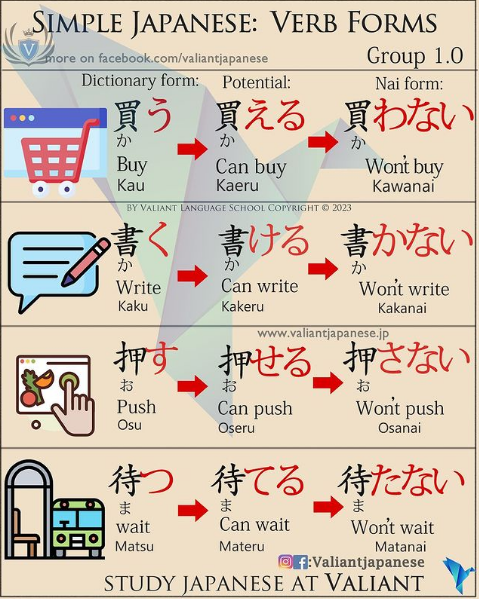
In English, verb tenses convey information about when an action occurs – past, present, or future. Similarly, in Japanese grammar, four key verb tenses exist:
Masu Form (Present/Future): The masu form politely expresses present and future actions. It is formed by adding “~masu” to the verb’s stem.
Example:
Taberu (to eat) ⟶ Tabemasu (eat/eating/will eat)
Past Tense: To indicate actions that occurred in the past tense in Japanese, we use the “~ta” form. To construct it for verbs ending with “-ru”, you replace “-ru” with “-ta”. For verbs ending with “-u”, you replace “-u” with “-imashita.”
Example:
Taberu (to eat) ⟶ Tabemashita (ate)
She went to school. ⟶ Kanojo wa gakkō ni ikimashita
Te Form (present progressive): The te form expresses continuous or ongoing actions in the present. It is formed by replacing “~ru” or “~u” with “~te.”
Example:
Tabemasu (eat) ⟶ Tabeteimasu (eating)
Negative Tense: Negative tense is formed by adding “nai” after the verb’s stem. To make it polite, we use “〜masen.”
Example:
Tabemasu (eat) ⟶ Tabemasen (don’t eat)
Understanding and utilizing these verb tenses will enhance your ability to communicate in Japanese effectively.
In conclusion, navigating beginner Japanese lessons requires attention to sentence structure and verb tenses. You can construct proper sentences by understanding the SOV sentence structure and how particles function. With time and dedication, you’ll soon find yourself on the path to becoming fluent in this beautiful language.
Frequently Asked Questions (FAQs) Japanese Grammar
Where can I learn Japanese grammar as a beginner?
Valiant Japanese Language School has beginner-friendly Japanese grammar courses. You can learn online or in-person.
What is the basic sentence structure in Japanese?
Japanese sentence structure is based on a subject-object-verb (SOV) structure which means the verb is always at the end of the sentence unlike in English.
Why are particles important in Japanese grammar?
Japanese grammar is based on sentence structure and the use of the words “wa,” “ga,” “o,” and “ni” helps define the subject and object roles in sentences.
What are the main verb tenses in Japanese?
Japanese verb tenses include present and future in the masu form, the past form which end in ~ta, the te form which represents the continuous, and a negative form which end in ~nai or ~masen.
Is Japanese grammar difficult for beginners?
When learning Japanese grammar, beginners encounter the use of confusing particles and different structures which is why patience is necessary to mastery.
How can beginners improve Japanese grammar quickly?
To improve quickly, Japanese beginners should learn the sentence formation, the essential Japanese particles, the basic Japanese verb tenses, and lessons at the Valiant Japanese Language School.
What is the best way to learn Japanese grammar?
The best way to study Japanese grammar is learn classroom-instructed Japanese grammar and practice the learned rules through context.
How long does it take to learn basic Japanese grammar?
An average beginner will likely understand core concepts of Japanese grammar within a couple of months, given sufficient practice and the right instructions.
 Call Now
 Enquiry Now!