

There has genuinely never been a better time to start learning Japanese. Online platforms now make it possible to build a real foundation before you ever set foot in Japan — and that, in turn, makes the in-person experience far more useful when you do get there. For most beginners, the smartest path is a…

35 Popular Japanese Proverbs and Their Meanings
Japanese proverbs — kotowaza (ことわざ) — are tiny carriers of culture. Each one packs a piece of philosophy, observation, or hard-won wisdom into a single line, and they’ve been passed down across generations almost intact. Many touch on patience, humility, and the realities of human nature; others are practical, even sharp. Beyond being beautiful in…

Oyasumi Meaning & Usage: How to Say Goodnight in Japanese
If you’ve spent any time learning Japanese or exploring the culture, you’ve probably come across oyasumi (おやすみ). It’s one of those small, everyday words that does a lot of work — politely wishing someone a good night, marking the end of a day, and quietly acknowledging the person you’re saying it to. This article walks…

Online Classes to Learn Japanese: A Complete Guide for Beginners
There are more and diverse motivations for learning Japanese than ever before. The Japanese language has become more accessible. There is no longer a need to live nearby to a language school. Japanese language online courses have become equal, if not better, than physical classrooms regarding available resources like native speakers to help. Analyzing this…
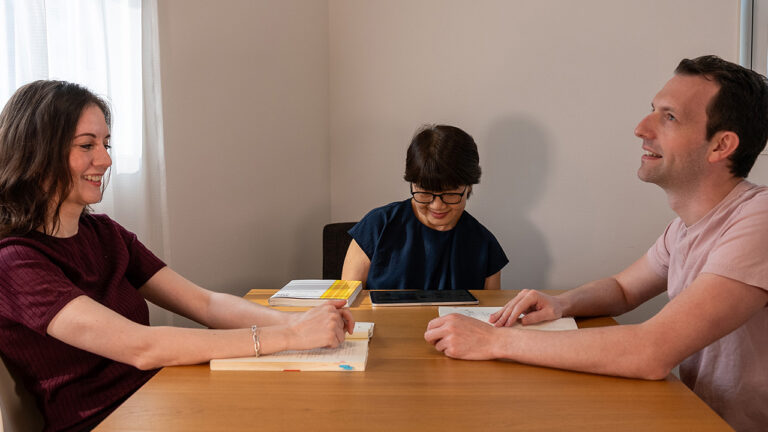
Japanese Swear Words Explained: Meaning, Usage & Cultural Context
Anyone learning a new language eventually gets curious about the rude parts of it. Japanese is no exception — anime, manga, and YouTube clips are full of words and phrases that English subtitles handle with surprising creativity. But Japanese swearing doesn’t work the way English swearing does. There are fewer hard-hitting curse words, and the…

16 Essential Japanese Greetings for Everyday Life
Greetings are the easiest way to start with Japanese — and arguably the most useful. They show up dozens of times a day in Japan, and they carry a lot of weight culturally. Knowing when to say what (and to whom) signals respect, awareness, and a real interest in the language. Whether you’re planning a…

Konnichiwa Meaning in English: When and How to Use It
If you’ve spent any time around Japanese — anime, language apps, a trip to Tokyo — you’ve almost certainly come across konnichiwa (こんにちは). It’s one of the first words most learners pick up, and it’s usually translated as a simple “hello.” That translation works, but it leaves out a lot. The actual meaning, timing, and…

Meaning and Usage of “Wakarimashita” in Japanese
Wakarimashita (わかりました) is one of the most frequently used expressions in the Japanese language. It comes from the verb wakaru (わかる), which means to understand. When used in the past polite form, wakarimashita literally means “I understood”, but in everyday conversation it is commonly used to mean “I understand,” “Got it,” or “Okay.” What Does…

How to say “I don’t want” in Japanese language
In Japanese, “I don’t want” can be said in a few different ways depending on how polite or casual you want to sound. Here are the most common and natural options 👇 Casual (with friends / informal) • いらない (Iranai) → “I don’t want it / I don’t need it” Very common and natural in…

Discover the Best Way to Learn Japanese: Valiant Japanese in Tokyo
The learning of the Japanese language can be difficult, but it can also be very rewarding. Finding the best possible way to learn Japanese is important when preparing for university entrance exams, planning to work in Japan, or wanting to speak with the locals. Valiant Japanese provides the assistance learners need to elevator their language…

Master Japanese in the Heart of Japan: Why Valiant Japanese Is Your Best Choice
Finding the best place to study Japanese is vital, especially if you’re looking to study the language seriously. In Japan, there are many options to study. However, if you want to find the best place to study Japanese, culture, and network for future careers, look no further than Tokyo. At Valiant Japanese, we design all…
Advance Your Japanese Skills with Valiant Japanese: Learn in Tokyo or Online
Learning the Japanese language can have many positive impacts on a person’s life. Living in and working with integrating into Japanese culture will be positively opened to you. Making the right choice in selecting a language program provider will help you learn the Japanese linguistically and culturally. At Valiant Japanese, you can select a culturally…

Learn Japanese with Confidence at Valiant Japanese in Tokyo
Japanese language education incorporates much more than vocabulary. It includes understanding a whole culture, unique styles of communication, and myriad language applications across a spectrum of different contexts. When looking to engage in day-to-day conversation, advance professionally, or stay in Japan for the long haul, the learning environment becomes extremely important. In Tokyo, there are…

How I Prepared and Passed JLPT N4: A Step-by-Step Journey
After months of finding various resources to help me, preparing for and passing the JLPT N4 was an achievement that I would never forget. For someone starting their Japanese learning journey, the reading, grammar, vocabulary, and comprehension sections of the exam are difficult to navigate. However, with the right dedication and resources, all of these…

Is “分かりました” Polite or Casual? Understanding Japanese Communication
As you are learning Japanese, it is highly likely that you have come across the term “Wakarimashita” ( わかりました ) multiple times. It is used frequently in Japanese schools, offices, and daily interactions. However, many learners have the same question. How to interpret “Wakarimashita,” is it impolite or is it formal? This is crucial in…
 Call Now
 Enquiry Now!